This week we find ourselves talking about the resurgence of the novella in fantasy and SF, the possible reasons behind it, the changes in recent print magazines Asimov’s and Analog, the question of why short fiction seems to be moving in a digital direction whereas the novel not so much–and then we segue unconvincingly into questions of what gets reviewed and by whom, finally ending up with the problems in trying to find a workable definition of fantasy as compared to science fiction or horror.
As part of the lead up to the publication of Bridging Infinity, Tor.com is reprinting Ken Liu’s terrific story “Seven Birthdays”. There’s more coming soon too, including a limited giveaway! For the moment, though try Ken’s story and consider picking up a copy of the book!
After a week off, we return to discuss just how science fictional the recent American elections are, whether political science fiction has ever had much impact on social attitudes or public policy, what if anything SF has to offer to the disenfranchised, and the representation of women and minorities as characters as well as contributors in recent anthologies like Jonathan’s Bridging Infinity. We also offer some thoughts on the recent World Fantasy Convention, the difficulties World Fantasy seems to be facing in terms of both awards and convention attendance, and whether there are really any professional conventions left in the SF field.
My story deals with a far-future engineering project to drill down into the Sun, for reasons that are explained in the story. But the story has its basis in the present, as the central protagonist is an Indian scientist who makes a critical discovery during her thesis work.
Q: What was the inspiration behind your story?
I wanted to keep very literally to the theme of “bridging”, and that meant some sort of physical structure connecting two points. I kept coming back to James Blish’s short story “The Bridge” about a vast engineering project on (or in) Jupiter, but I wanted to go beyond that to something truly nuts, but just about feasible at the extreme range of present speculation. I wanted to keep away from space elevators and wormholes! I’d read about the solar heliospheric oscillations during my own degree work, and it had always struck with me that there’s a lot we still don’t know about the interior life of stars. I also did some sniffing around about very high temperature materials, and found that creating an alloy that could survive on the surface of the Sun isn’t as mad as it sounds. The other inspiration for the story was drawing a parallel between the sometimes stressful business of defending your thesis work, and an actual interrogation.
Q: What do you believe makes a good science fiction story?
The ideal SF story would be written with a high level of literary craft, with an effective use of voice, viewpoint, structure and so on, perhaps some memorable characterisation, and it would also embed one or more interesting ideas in an original, surprising fashion. The experienced SF reader will be alert to the usual directions such a story might take, so the piece also has to work hard to subvert such expectations – while at the same time not short-changing the less experienced reader. In reality very few SF pieces ever hit all those high notes at once – none of mine ever has – but it’s a good set of objectives to aim for.
Q: What are you working on now? And if people like your story in the book, what other work of yours should they seek out?
I’m trying to nail down the latter part of a new novel, a sequel to my earlier book The Prefect, and which is set in the Revelation Space universe. If people like “Sixteen Questions”, I’d maybe suggest taking a look at my story “A Murmuration”, which also deals with science as a career, although from a rather different perspective.
“Rager in Space” is about peer pressure, and that moment when you realize that maybe you’ve outgrown your best friend. Sion and D-Mei have been inseparable since they were kids, and they’re unrepentant party girls in a world where artificial intelligence failed for some reason that nobody understands. It’s a sad sort of world where nothing quite works, because the computers tend to go on the fritz whenever you need them. But then Sion gets an invite to go into deep space on the first interstellar spaceship, which is basically one big party bus in space. And then she discovers the reason why the Singularity (that moment where computers become smarter than us) never lived up to its promise.
Q: What was the inspiration behind your story?Â
I had been tinkering with this story for a couple years, actually. I was interested in the idea of a couple of party girls going into space and maybe meeting aliens. For a while the story was called “YOLO,” which was absurdly dated even when I started writing it. It didn’t really click for me until I wrote the flashback to Sion’s childhood, where she’s struggling with the fallout from the failed Singularity and then D-Mei comes to her rescue. That made this into much more of a story about a weird friendship. And then I got obsessed with building out the spaceship and the A.I. politics and everything else.
Q: What do you believe makes a good science fiction story?
I’m tempted to say “the same thing that makes a good story of any sort.” Characters who go through something and are changed by it; a crux or conflict of some sort, that gets developed over the course of the narrative; a sense that the story is “about” something — some idea, some question, some thought experiment. Writing a science fiction story, I guess, lets you ask bigger and more ambitious questions, and build in a certain amount of complexity because SF readers are very comfortable with crunchy world building. And I love to start off with a crazy idea like “what if time travel was also space travel because of spatial displacement” and then build it into a personal narrative. Starting with the SFnal idea and then backing  into the personal story can be a lot of fun, as can the reverse. But I guess I’m admitting I have no idea what makes a good story, SF or otherwise, since every story is different. I guess a good story is one that lives on in your head after you’re done reading.
Q: Â What are you working on now? And if people like your story in the book, what other work of yours should they seek out?
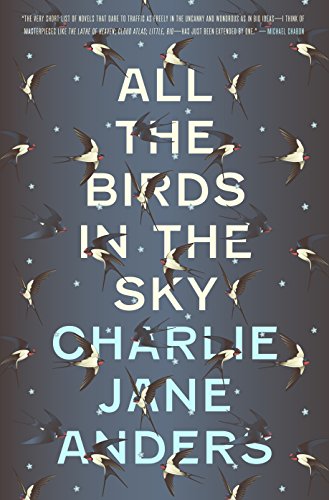
I’m working hard on my next novel for Tor, which is a lot less funny than “Rager in Space,” but hopefully just as weird. In the meantime, I should put in a plug for my novel All the Birds in the Sky, which came out back in January, plus I have stories in the recent anthologies Drowned Worlds and The Starlit Wood. If you can hunt down a copy of the summer 2016 issue of Catamaran Literary Reader, I have an incredibly weird story about a sex cult who creates their own afterlife. Oh, and it’s a ways off, but I have a story in John Joseph Adams’ space opera anthology Cosmic Powers, which might be the funniest thing I’ve ever written (or might just be kind of silly.)