
Best Science Fiction and Fantasy Nine is out!

bestsff9The Best Science Fiction and Fantasy of the Year: Volume Nine (Solaris) is due out in shops today! It’ll be out in the UK in a week or so. I’m really happy with this book and hope you’ll consider taking a look at it.

The stories in the book are:

1. “Tough Times All Over”, Joe Abercrombie
2. “The Scrivener”, Eleanor Arnason
3. “Moriabe’s Children”, Paolo Bacigalupi
4. “Covenant”, Elizabeth Bear
5. “Slipping”, Lauren Beukes
6. “Ten Rules for Being an Intergalactic Smuggler (The Successful Kind)”, Holly Black
7. “Shadow Flock”, Greg Egan
8. “The Truth About Owls”, Amal El-Mohtar
9. “Cimmeria: From the Journal of Imaginary Anthropology”, Theodora Goss
10. “Cold Wind”, Nicola Griffith
11. “Someday”, James Patrick Kelly
12. “Interstate Love Song (Murder Ballad No.8)”, Caitlin R Kiernan
13. “Mothers, Lock Up Your Daughters Because They are Terrifying”, Alice Sola Kim
14. “Amicae Aeternum”, Ellen Klages
15. “Calligo Lane”, Ellen Klages
16. “The Lady and the Fox”, Kelly Link
17. “The Long Haul From the ANNALS OF TRANSPORTATION”, The Pacific Monthly, May 2009”, Ken Liu
18. “The Vaporization Enthalpy of a Peculiar Pakistani Family”, Usman T Mailk
19. “Four Days of Christmas”, Tim Maughan
20. “The Fifth Dragon”, Ian McDonald
21. “Shay Corsham Worsted”, Garth Nix
22. “I Met a Man Who Wasn’t There”, K. J. Parker
23. “Kheldyu”, Karl Schroeder
24. “Tawny Petticoats”, Michael Swanwick
25. “Grand Jeté (The Great Leap)”, Rachel Swirsky
26. “The Insects of Love”, Genevieve Valentine
27. “Collateral”, Peter Watts
28. “The Devil in America”, Kai Ashante Wilson

I think it’s a terrific lineup,  and makes for a great book.

Where can you buy it?

Glad you asked. If you’re interested in grabbing a copy, these fine retail outlets should have it:

I also would encourage you to try your local independents. My own two favourites here in Perth are:

but there are great retailers everywhere, like Borderlands in San Francisco, Pulp Fiction in Brisbane, Slow Glass in Melbourne, all of whom would be happy to help you out.

If you do pick up the book, I hope you enjoy it.
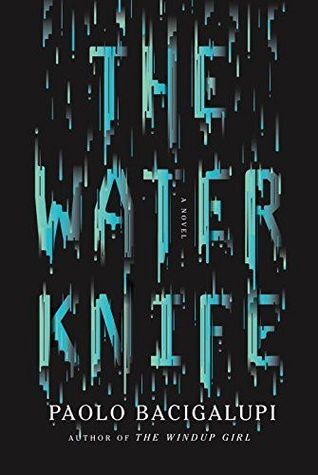


Episode 233: Paolo Bacigalupi and The Water Knife


This week we are joined by the Hugo and Nebula Award winning Paolo Bacigalupi, who is just about to publish his first science fiction novel for adults since 2009s The Windup Girl

Picking up from where his harrowing short story “The Tamarisk Hunter” left off, The Water Knife is lean thriller that asks important questions about how global warming will affect us all as seas rise in some places and drinking water becomes scarce in others.
The publisher of the book describes  The Water Knife like this:
In the American Southwest, Nevada, Arizona, and California skirmish for dwindling shares of the Colorado River. Into the fray steps Angel Velasquez, detective, leg-breaker, assassin and spy. A Las Vegas water knife, Angel “cuts” water for his boss, Catherine Case, ensuring that her lush, luxurious arcology developments can bloom in the desert, so the rich can stay wet, while the poor get nothing but dust.

When rumors of a game-changing water source surface in drought-ravaged Phoenix, Angel is sent to investigate. There, he encounters Lucy Monroe, a hardened journalist with no love for Vegas and every reason to hate Angel, and Maria Villarosa, a young Texas refugee who survives by her wits and street smarts in a city that despises everything that she represents.  With bodies piling up, bullets flying, and Phoenix teetering on collapse, it seems like California is making a power play to monopolize the life-giving flow of a river. For Angel, Lucy, and Maria time is running out and their only hope for survival rests in each other’s hands. But when water is more valuable than gold, alliances shift like sand, and the only thing for certain is that someone will have to bleed if anyone hopes to drink.

The conversation is, as always, fascinating and provocative. We’re very grateful to Paolo for making the time to return to the podcast and, as always, hope you enjoy the episode.

Paolo Bacigalupi on the podcast

waterknife.jpg This weekend Paolo Bacigalupi returns to Coode Street and the Gershwin Room to discuss his major new novel, The Water Knife, which will be in stores in a few weeks.

The Water Knife is Paolo’s first SF novel for adults since The Windup Girl and is already receiving widespread praise. The publisher describes the book like this:
WATER IS POWER
 
Paolo Bacigalupi, New York Times best-selling author of The Windup Girl and National Book Award finalist, delivers a near-future thriller that casts new light on how we live today—and what may be in store for us tomorrow.

The American Southwest has been decimated by drought. Nevada and Arizona skirmish over dwindling shares of the Colorado River, while California watches, deciding if it should just take the whole river all for itself. Into the fray steps Las Vegas water knife Angel Velasquez. Detective, assassin, and spy, Angel “cuts” water for the Southern Nevada Water Authority and its boss, Catherine Case, ensuring that her lush, luxurious arcology developments can bloom in the desert and that anyone who challenges her is left in the gutted-suburban dust.

When rumors of a game-changing water source surface in Phoenix, Angel is sent to investigate. With a wallet full of identities and a tricked-out Tesla, Angel arrows south, hunting for answers that seem to evaporate as the heat index soars and the landscape becomes more and more oppressive. There, Angel encounters Lucy Monroe, a hardened journalist, who knows far more about Phoenix’s water secrets than she admits, and Maria Villarosa, a young Texas migrant, who dreams of escaping north to those places where water still falls from the sky.

As bodies begin to pile up and bullets start flying, the three find themselves pawns in a game far bigger, more corrupt, and dirtier than any of them could have imagined. With Phoenix teetering on the verge of collapse and time running out for Angel, Lucy, and Maria, their only hope for survival rests in one another’s hands.  But when water is more valuable than gold, alliances shift like sand, and the only truth in the desert is that someone will have to bleed if anyone hopes to drink.


It was a lot of fun talking to Paolo about the book. We hope you’ll join us this weekend to hear the conversation.

Episode 232: On canon formation (again)

This week we return, without guests, to a topic with which we have annoyed listeners in podcasts for years—the idea of SF canon formation: who gets dropped from the canon, who gets added, and whether such things as Hugo nominations make any difference at all.

The decade between 1985 and 1995 (20-30 years ago now), saw the deaths of many of the writers who helped establish much of the “classic” SF canon — Robert A. Heinlein, Isaac Asimov, Theodore Sturgeon, Frank Herbert, Alfred Bester, Fritz Leiber, John Brunner, Roger Zelazny, James Tiptree Jr, Cliffard Simak, Lester del Rey, Philip K. Dick, C.L. Moore, and more.

Who among them are still being discovered by new readers, and which writers and books in the last 20 years are likely candidates for a future canon? Does it take 50 years or more to determine what is canonical? Are Hugos any sort of reliable guide? And what difference do canons make anyway, beyond collective lists of personal favorites?

We also have decided, as announced in the podcast, to officially support the Helsinki in 2017 and Dublin in 2019 WorldCon bids. Coode St endorses these conventions, will be buying memberships to them, and will attend should they be successful. Both Gary and Jonathan are eager to be part of major international WorldCon events like 2014’s Loncon. We hope you’ll join us in supporting these great bids.

We hope you enjoy this week’s episode. Next week: Paolo Bacigalupi and The Water Knife!


Katherine Addison’s The Goblin Emperor

The Goblin Emperor is a fine secondary world fantasy by Sarah Monette writing as Katherine Addison. It tells the compelling story of a young boy Maia, cast-off half-breed son of a pureblooded elf emperor, who finds himself suddenly and unexpectedly forced onto the throne when his father and three brothers are all killed in an airship accident. The_Goblin_Emperor_cover

Maia’s life to this point had been a simple and rather miserable one. His father, the emperor, had no love for him or his mother, a goblin he wed for diplomatic reasons. When she died just before his eighth birthday, the emperor banished Maia to a remote manor to be raised by a man who hated him and treated him poorly.

With little education and no knowledge of a large politically complex court, Maia is faced with an almost insurmountably difficult task, which he attempts with a grace and kindness far beyond seems reasonable to expect from him. And this may, ultimately, be the one small flaw in this immensely likeable book. Maia is far from welcomed at court, and his little reason to like or love the people he finds there. He is a nineteen year old boy, used and abused by circumstance, and yet he is consistently resourceful, intelligent and kind to the people he encounters. He shrugs off casual racism, attacks entrenched sexism, and even when his  life is threatened, he is forgiving and almost regretful of having to allow the law to run its course in dealing with such crimes. It’s a little hard not to question whether there might have been more anger, more lashing out from a young man.

The core question of the book, though, seems to be whether a genuinely good person can wield power without being corrupted or damaged by it. Is it possible for Maia to hold imperial power and not be forced to make difficult questions that have no good outcomes, just different ones? Maia doesn’t really have to face this in The Goblin Emperor. On several occasions he is faced with situations that have genuinely upsetting outcomes – he takes no pleasure in the honour suicide of a personal guard who betrayed him or in the execution of several traitors to the throne – but he is not really tested by the moral grey areas of a complex world.

That said, The Goblin Emperor is, as I said, immensely likeable. Maia is an engaging protagonist, the Elflands and the elf court that Addison creates are complex and interesting, the secondary characters are deftly drawn, and the story is one of those that seems to run before you until you’re faced with the sad realisation that those last few pages are appendices and not more story (one of the saddest realisations in all fantasy, surely!).

The Goblin Emperor is nominated for the Nebula and Hugo Awards, and is a worthy nominee for both. It will likely get my vote for the latter, though it is hard to decide between it and Cixin Liu’s The Three Body Problem.  I also expect to see it on the World Fantasy and other ballots later this year. A strongly recommended book that has left me looking forward to Addison/Monette’s next novel with great  anticipation.

…unavoidable stuff from jonathan strahan…