
The Future of Short Fiction

I know that I go on and on about things that Coode Street’s faithful readers should check out and maybe buy, but I don’t run advertising and I don’t accept any enducements to mention things in this space. Instead, I rabbit on and on about things I am genuinely enthusiastic about, and hope that it proves of interest to you, my readers.

The reason I mention this has, peripherally, to do with World Fantasy. As you know, I was in Madison for the annual WFC a couple weeks back. It had been my intention to sit down at the bar with Deb Layne, proprietor of Wheatland Press, but time and circumstance conspired against that happening. Instead, we had a couple of glancing conversations and promised to catch up in email.

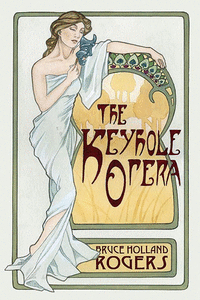
The one thing Deb did get to do was give me a copy of her latest publishing endeavour, a new Bruce Holland Rogers collection, The Keyhole Opera. Rogers has won the World Fantasy Award for his short fiction, has written some very cool stories over the past few years, and is one of the best of the regular contributors to Shawna McCarthy’s Realms of Fantasy magazine. The Keyhole Opera collects a bunch of short-shorts, along with an introduction by Michael Bishop. I’ve only started dipping into the collection since I’ve got home, but I think you should check it out.

All of which segues into a missive from Bruce that I received this morning. For the past four years now, Rogers has been making his short fiction available in a pretty unique way. For just a tiny amount of money, you can subscribe and receive short-short stories by email. Stories go out three times a month, and range from literary fiction, science fiction, fairy tales, and mysteries, to work that is pretty much unclassifiable. You get thirty-six stories for five dollars, and the stories range in length from 200 to 2,500 words.

I don’t know if this is the future of short fiction distribution, or not. Right now, I don’t think anyone knows the answer to that. I do know, though, if you go to www.shortshortshort.com you can try before you buy, sample a bunch of short stories, and maybe even decide to order his new collection.

On young adult fiction…

What is so moving about the Narnia stories is that, though Lewis began with a number of haunted images … he never wrote down to, or even for, children, except to use them as characters, and to make his sentences one shade simpler than usual. He never tries to engineer an entertainment for kids. He writes, instead, as real writers must, a real book for a circle of readers large and small…

— Adam Gopnik, ‘Prisoner of Narnia’, The New Yorker

I’ve spent a lot of time reading, and some time thinking about, the kind of fiction that is sold as ‘young adult fiction’ at the moment. The above quote, which comes from a New Yorker article about C.S. Lewis, is as good an explanation about writing ‘young adult’ fiction that I’ve heard.

Is the Wayback Machine enough?

The announcement from SciFi.com that it will close SciFiction at the end of the year has sparked a lot of discussion. One of the many points touched on that is worthy of expansion is mentioned by Locus Online‘s Mark Kelly. In a post entitled “Into the Aether“, Kelly pondered what happens to defunct websites? How do we access the material that was published after the website has been taken down? After all, paper magazines and books have a life long after their publication date. You can usually pick up old issues second hand, or in libraries, and I own any number of books published by now defunct publishers. What do you do if you want to access material from a defunct website?

The best answer is to go to The Internet Archive’s ‘Wayback Machine’ (www.archive.org). The IA is a non-profit that was founded to build an ‘Internet library,’ with the purpose of offering permanent access for researchers, historians, and scholars to historical collections that exist in digital format. It’s Wayback Machine spiders the web making full and partial copies of websites. It currently archives 40 billion web pages (according to its own site information).

Although it is a good thing, there are problems with the Wayback Machine. The first is that copies are often partial, or difficult to find. For example, following the announcement that SciFiction was to close, I decided to research what fiction Ellen Datlow had edited for publication online. Looking back at Omni Online I struggled to find a full copy of Omni’s short fiction from 1995 to 1998. Some of it was not there, and to get to other pieces I had to navigate through multiple iterations of the old Omni site, often stumbling down blind alleys to no longer extant pages. There was a more complete copy of Event Horizon (1998/1999), but the SciFiction copy was also incomplete, containing a full copy of Suzy McKee Charnas’s “Peregrines” (removed from the current SciFi.com site at the request of the author), but missing anything from this year (for example). Some of the omissions are because people have asked for material to be removed, or because web pages are set not to be archived, but in many cases it’s just not possible to archive everything.

The question that then follows is, to what extent are works published online ‘lost’ when the originating website goes offline. Well, while the record of the periodical becomes difficult to trace, and its own story may ultimately be lost, but many of the stories published do become widely accessible. For example, stories like Dan Simmons’ “Looking for Kelly Dahl” (Omni Online), Kelly Link’s “The Specialist’s Hat” (Event Horizon”, and Andy Duncan’s “The Pottawottamie Giant” (SciFiction) have all been fairly widely reprinted and access to them was or is unlikely to be affected by the closure of a website. The fate of stories like Michael Bishop’s “Cyril Berganske” (from Omni, and only reprinted once since) or A.R. Morlan’s “Ciné Rimettato” (from SciFiction, and never reprinted), is less sure, though.

Is there a solution? Well, supporting The Internet Archive is a good start. Encouraging the print publication of material is better, and even just ensure good bibliographical records is worthwhile. Otherwise, a goodly portion of the current range of short fiction being published will be lost, something the field could ill-afford.

The ED SF Project

The estimable Dave Schwartz (with worthy assistance from Niall Harrison and Chance) have set up The ED SF Project, a worthy tribute to Ellen Datlow’s SciFiction. They’ve asked a bunch of people to write appreciations for the 300+ stories published on SciFiction. I think it’s a wonderful project, and will definitely get involved. I also hope they’ll eventually consider expanding it to cover Ellen’s online editing at Omni Online and Event Horizon, which also included some amazing stories.

NB: This post was edited. That’s the way it goes.