Rising sea levels threaten Anguilla, but businessmen can always make a buck. It’s up to an ex-astronaut to save the ordinary people from his half-brother if he can. With the help of an engineer. From the depths of a shaft drilled the full thickness of Earth’s crust.
Q: What was the inspiration behind your story?
A combination of: Journal articles on Russian and Icelandic deep-drilling efforts, and wondering why they didn’t drill where the crust was thinnest. Renewable energy research. Alzheimer’s disease striking my friends and family. A chance encounter with someone who grew up on Groote Eylandt.
Q: What do you believe makes a good science fiction story?
Good balance between storytelling craft and rigorous extrapolation of scientific discovery/application/societal impact.
Q: What are you working on now? And if people like your story in the book, what other work of yours should they seek out?
I’m working on Book 2 of my fantasy trilogy, “Echoes of Understorey”. If people like the characters in my story, they can buy Book 1 in January 2017,”Crossroads of Canopy. If short stories are preferred, my 4-story collection Asymmetry is about 50/50 science fiction and fantasy. If only science fiction will do, my story “Going Viral,” in Issue 8 of free online magazine Dimension 6 from Coeur de Lion, follows a brother and sister battling both tradition and an engineered rabies outbreak on an alternate-history Sumatra.
At his best, Jonathan Carroll is a master at subtly and perceptively portraying the foibles of the human condition. You can see it in everything from early novels like Bones of the Moon and Sleeping in Flame to more recent work like The Ghost in Love andBathing the Lion. And while he’s not best known for his short fiction he has nonetheless managed to build quite an impressive bibliography. His fine 2012 collection The Woman Who Married a Cloudcollects his slightly strange, intimate, and humane ruminations on the oddities of the human condition and is endlessly impressive. Although, perhaps “Friend’s Best Man†aside, he’s not been widely awarded or applauded for his short fiction, his recent work holds up remarkably well. I think a story like 2005’s “Home on the Rain†should’ve made awards ballots and would have made my own year’s best were conditions different, while novella Teaching the Dog to Readrepays close attention.
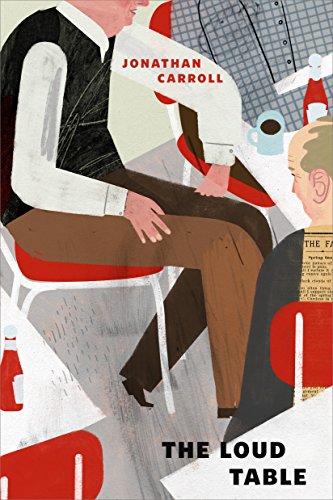
Carroll can usually be depended on to produce a new work of short fiction every year or two, and they often stand out as being among the year’s very best. Which is why I was very interested to see his new short story, “The Loud Table“, appear at Tor.com today. It’s a really interesting piece, but I’m not sure it’s completely successful. Edited by Ellen Datlow, “The Loud Table“ tells the story of four elderly men who meet every day at a local cafe to sit, talk, drink coffee, solve the world’s problems, and more importantly, to fill their long, empty days.
Carroll beautifully sketches in the quartet, touching movingly on the hard won matters of old age; the friends and loved ones lost to time or illness; the ravages time has wrought on body, soul and memory. And the unexpected friendships found late in life that fill long, lonely days with something that is fulfilling and worthwhile. Â The driver behind the story is that the quartet’s meeting spot is closing for renovations. For a month or two or three, these lost souls will be without a cafe to call home and they’re unhappy about it. They try this cafe, which is too loud, and that one, which has lousy coffee. Eventually it’s suggested they try a local gay cafe, the Tough Nut. They balk for a moment, but are surprised to find, opening hours aside, that it’s a wonderful fit where they feel welcome (it doesn’t hurt that the cake is good).
And then Carroll adds the second driver to the story. One of the quartet, Conrad, fears he may be suffering from Alzheimer’s Disease. When Tough Nut‘s much younger proprietor joins them for coffee one morning, they end up discussing what they miss, what they’d like restored that they may have lost in their journey from young to elderly men. Conrad can’t remember a long ago lover’s face, but he dearly wants to. It’s here that Carroll adds his intimations of mortality and for a moment the story sings. And then…
This is where you need to go and read the story. I’m not going to fill in the gaps, but Carroll makes some unexpected choices in telling his tale, moving it firmly into science fictional territory. I felt this part of the tale really doesn’t seem to fit what came before, and seemed both out of place and strangely old-fashioned. Almost like a slice of ’50s or ’60s Ray Bradbury dropped into the mix. I don’t think the story really recovers from this, moving it from being potentially wonderful to being oddly disappointing. I don’t think “The Loud Table” ranks among Carroll’s best, or among the best of the year, but he’s always interesting and it’s worth reading.
I’m grateful to Datlow and Tor.com for the chance to read “The Loud Table“, but hope for something even better next time.
I have just signed up to join the 190 other people who are planning on attending the 2017 World Fantasy Convention in San Antonio, Texas in November 2017. Now is a great time to buy a membership, given the price will rise tomorrow (from $150 to $225).
I think it’s also a great time to show support for the convention. There were some issues in the run up to the Columbus event, which seems to have gone off very well, but the convention did attempt to address them. I think there’s a good chance 2017 will be great, though that depends on everyone showing up!
With Karen Joy Fowler, Greg Manchess, David Mitchell, Gordon Van Gelder and Martha Wells lined up as guests, it certainly looks great. And with all sorts of cool people already signed up to attend, it should be a lot of fun.
Still, 190 out of a possible 950 attendees… There could be more. I know that number is low because Garth and Sean and I just bought memberships. Will we see you there? Aussies? I hope so!
This week, from the World Fantasy Convention in Columbus, Ohio, Gary is joined by Hugo-winning David Levine (Arabella of Mars) and Andre Norton-winning Fran Wilde (Updraft, Cloudbound) to discuss various matters from Regency interplanetary adventures to bone cities to where SF titles come from,and balances between SF, fantasy, pulp traditions, and YA elements in SF’s emerging new eclecticism.
As always, our thanks to David and Fran for making the time to talk to Gary. We hope you enjoy the episode!


 Â Â
  