
The email’s gone off and should be in the relevant editors in-boxes, so I think it’s safe to tell you all that Gardner Dozois and I have delivered The New Space Opera to HarperCollins in Australia and the US. The 200,000 word anthology will be published in trade paperback in June 2007, and will feature the fabulous artwork of Stephan Martiniere on the cover (as mentioned here earlier). I’m very happy with the book, and can’t wait to see what you all think of, once it hits the shelves. Oh, and Gardner and I have been hard at work, and are in the planning stages for a possible NSOII (fingers crossed).
Category Archives: Science fiction
Space opera
I’ve been discussing this with Ellen Datlow in the comments to the previous post, but I thought I’d encourage comments here on this question:
What do you mean by ‘space opera’?
Come one, come all. I’d love to know. I have a pretty broad definition of it, but I’d love to hear what others think.
No new space opera
Here’s a thought: there’s no such thing as the new space opera. It’s not that there haven’t been profound developments in the evolution of space opera over the past twenty five years. There have been. It’s not that those developments don’t coincide with what people (myself included) have been calling the ‘new space opera’. They have. The problem is that there’s been an error of perspective.
If you step back just a little over a hundred years Garrett P. Serviss wrote a novel, a media tie-in actually, that has some claim to being the first major pre-space opera novel. It had most of the characteristics of space opera that we recognise today. The next major work, Doc Smith’s Skylark of Space in 1928 took things a step further, ramping up the scale and drama incredibly, and Smith did it again with the Lensman novels. Campbell rang his changes on it, as did Heinlein, Asimov, Van Vogt, Kuttner, Moore and others. Blish, Vance and others improved the quality of writing, characterisation etc through the 50s, and in the 60s you began to see more experimental works, as well as work by Dickson, Anderson, and Delany. The mid-70s saw a major shift with Mike Harrison’s space opera killer The Centauri Device, and then Interzone ran it’s call to arms in the early ’80s, Iain Banks introduced the Culture, and Stephen Baxter, Paul McAuley et al improved the science, the quality of writing etc that was common in space opera. Writers like C J Cherryh also made major contributions, especially in a world building sense, with detailed and intense portrayals of socio-economic forces in novels like Downbelow Station. You can then skip across Colin Greenland’s Take Back Plenty, Baxter’s work of the ’90s and on to writers like Alastair Reynolds, who bring a darkness and density to what they’re doing. It’s all space opera. A continuous evolution in the field.
So, what do I mean? Well, if all of that stuff is ‘space opera’ and not ‘new space opera’ or ‘old new space opera’ or ‘new old space opera’, then is there something else? Yes. Space opera has always been popular. It has always been science fiction’s dominant form, even when it wasn’t cool or whatever. And throughout space opera’s history there have been writers of ‘retro space opera’: writers who continue to create older forms of space opera for reasons of art or commerce. They effectively pastiche space opera, rather than partake of its continuing evolution. There’s nothing wrong with that, but it creates the impression that there’s space opera (that old stuff) and something new. It’s an error of perspective. There’s actually space opera and that other old stuff. I’m just saying.
Weekending
A four day weekend, and all I can think about is work. I like the idea of packing the family up and heading South, maybe to a small B&B. Putting the feet up, read Flora Segunda, and do fun things with the kids. Instead, I’m finishing off my last bit on The New Space Opera (for the moment), thinking about year’s bests, and working on an interview for Jeff (trying not to make it too dull). I’ll probably watch the Grand Final today, and we’re headed out to dinner with the Cabal tonight, so that should be good. Think I could do with a little time off, not physically, but mentally.
New Space Opera
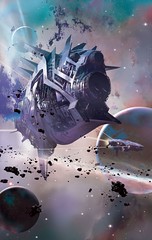
Exciting news! Just got a first sneak peek at the cover art for The New Space Opera. The artwork is by the fabulous Stephan Martinere and will be used on both the US and Australian editions of the book. I think he’s done a spectacular job with the cover art, and am delighted with it. Many thanks to my fabulous editor Stephanie and everyone at HarperC Australia who arranged it.